

2026-01-07
Coming-of-age
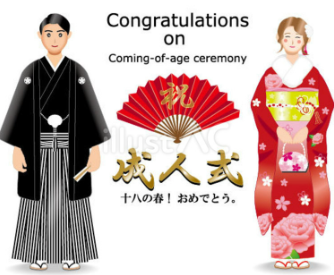
『Coming of Age Day』 is a national holiday in Japan that celebrates new adults, and it is observed on the second Monday of January each year. Its purpose is to congratulate young people who have reached adulthood and to encourage them as they begin to take responsibility for their own lives. The holiday is said to have been established as a modern equivalent of the traditional coming‑of‑age ceremonies: 『GENPUKU』 for boys and 『MOGI』 for girls.
『GENPUKU』
From the Nara period onward, boys from aristocratic and samurai families underwent a coming‑of‑age ceremony between the ages of about 12 and 16. In front of their guardian deity, they changed into adult clothing, altered their hairstyle from a child’s style to an adult’s, and wore a formal crown to signify adulthood. This ceremony was also called 『UIKABURI』 (literally “first crowning”).
『MOGI』
For girls, the coming‑of‑age ceremony involved wearing a 『MO』, a long garment worn from the waist down. On the day of the celebration, a respected person served as the “waist‑tying attendant,” fastening the sash of the mo. The girl would also apply makeup and sometimes blacken her teeth as part of the ritual. Unlike boys, there was no fixed age for this ceremony; it was often performed when a marriage partner had been decided.
ーHistory of Coming of Age Dayー
• Military Service in the MEIJI Era
From the MEIJI period onward, men in Japan were required to serve in the military. To do so, they had to undergo a conscription examination, and this examination came to serve as a kind of coming‑of‑age milestone.
• The Beginning of the Modern Coming‑of‑Age Ceremony:『Youth Festival』
The origin of the modern Coming of Age Ceremony can be traced back to the 『Youth Festival』 held in 1946 in Warabi City, Saitama Prefecture. This event was organized to encourage young people during the difficult postwar years, and it became the prototype for today’s ceremony. The idea spread nationwide, and in 1948, Coming of Age Day was officially established as a national holiday.
• From 1984: January 15 Becomes Coming of Age Day
After mandatory military service was abolished following World War II, a legal revision in 1984 officially designated Coming of Age Day as a national holiday. Until 1999, the Holiday Act set the date as January 15. This date is believed to have been chosen because, since the Nara period, the traditional coming‑of‑age ritual for boys—the GENPUKU Ceremony—was held on January 15, the day of KOSHOGATSU (Little New Year).
• Since 2000: The Second Monday of January
Starting in January 2000, the Happy Monday System was introduced to increase the number of three‑day weekends. Under this system, several national holidays—such as Marine Day, Respect for the Aged Day, and Sports Day—were moved from fixed dates to specific Mondays. Coming of Age Day was one of the holidays affected, and its date was changed from the fixed January 15 to the second Monday of January, which remains the current schedule.
ーChanges in the Legal Age of Adulthood and Their Impactー
・In April 2022, the legal age of adulthood in Japan was lowered from 20 to 18.
・At age 18, individuals gain the ability to enter contracts and obtain the right to vote; however, the legal age for drinking alcohol, smoking, and gambling remains 20.
・Many municipalities continue to hold Coming of Age ceremonies for 20‑year‑olds, and some have changed the name of the event to titles such as “Celebration for Twenty‑Year‑Olds.”
The attire for the ceremony is typically elegant and formal. Women often wear hakama, while men commonly wear suits or hakama. In recent years, participants of foreign nationalities have also taken part, sometimes wearing traditional clothing from their home countries. Internationally, many countries recognize 18 as the age of adulthood, but it is rare for a nation to hold a formal ceremony to celebrate it as Japan does. As new members of society, we hope they create wonderful memories while respecting rules and proper manners.
References
『Omoitatta ga Kichijitsu』
https://hatibunme.com/what-is-coming-of-age-day-everything-about-its-meaning-history-etiquette-for-dress-code-and-how-to-spend-the-day/
『HugKum』
https://hugkum.sho.jp/178992